
If You Want to Understand Why People Love Spider-Man, Watch ‘Spider-Man 2’
Spider-Man’s greatest enemy is not who you think. It’s more implacable than Green Goblin, more relentless than Doctor Octopus, and more persistent than Venom.
Spider-Man’s ultimate adversary is time.
Peter Parker can stick to walls, lift a car, and swing on webs through the canyons of New York City. But those things are meaningless in the face of time. There are simply not enough hours of the day for Peter to do everything he wants to do and everything he needs to do as his wall-crawling alter ego. No matter how many times he beats Norman Osborn and Otto Octavius, he’ll never defeat time. Every day, he must chose: Do I make myself happy as Peter Parker, or do I do the responsible thing and help people as Spider-Man? He can never do both.
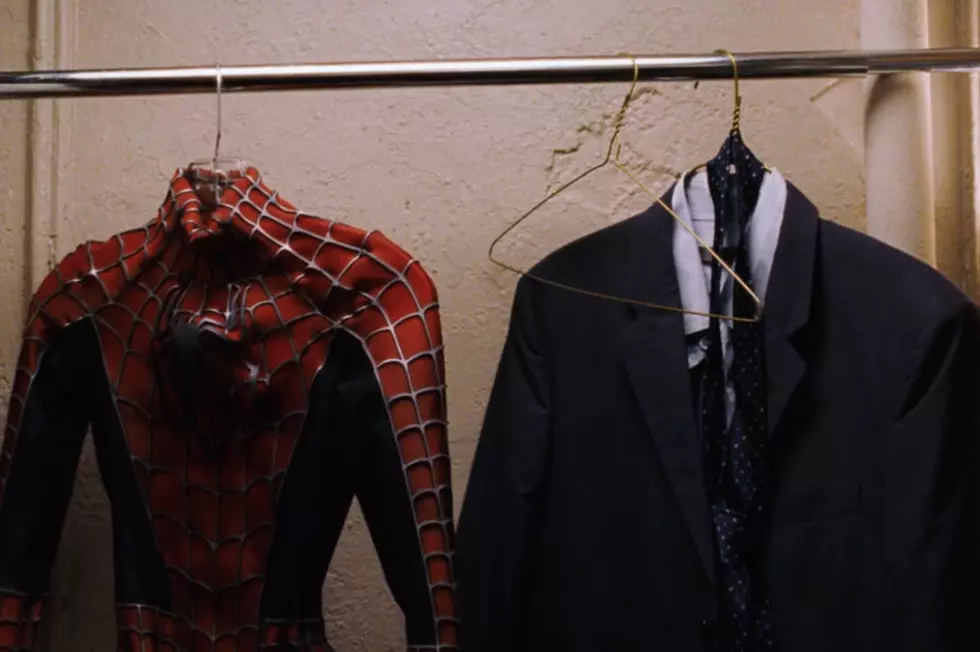
That is the secret sauce to every classic Spider-Man story; the fact that he’s two people sharing one life, and that every victory for one invariably causes problems for the other. That is why Spider-Man 2 remains the most beloved live-action Spider-Man movie. Because no other film about the character portrays that central dilemma onscreen, or distills it down to a single image like the elemental one above — Peter Parker looking into his closet and seeing a suit hanging next to his Spider-Man costume.
Mary Jane is performing on Broadway and she wants him to come to the show. But coming to the show means a night not patrolling the city as Spider-Man. People might get hurt; they could even get killed. What should he do?
READ MORE: The 50 Best Superhero Movies of the Last 50 Years
By the standards of modern superhero movies — where the fate of the entire multiverse is constantly on the line — Spider-Man 2 is impossibly small in scale. In the wake of the first Spider-Man, Peter Parker (Tobey Maguire) lives a lonely existence alone in Manhattan, doing his best to keep up with this college coursework while protecting New York as Spider-Man.
With his grades slipping, a professor introduces him to a brilliant scientist named Otto Octavius (Alfred Molina), hoping he might take him under his wing. He does — but then Octavius’ latest experiment goes horribly awry, fusing four metal arms to his body and frying the inhibitor chip that allowed him to control them. Now under sway of the arms’ artificial intelligence — a hilariously prescient storyline for a movie made almost 20 years before ChatGPT became a household word — Octavius rebuilds his lab and sets out to recreate the experiment that ruined his life.
And that’s it. Spider-Man 2 is less about world-breaking stakes than about terrible burden of choices; whichever one Peter Parker makes, it always seems to be the wrong one. The movie opens with Peter in trouble at his job delivering pizzas. (“To you Parker, a promise means nothing!” his boss screams, a winking joke about the fact that Peter’s life is dominated by the ultimate promise — to honor Uncle Ben’s death as Spider-Man.) If Peter doesn’t deliver an massive pile of pizzas in an impossibly short amount of time, he’ll be fired.
And what does Peter do? He pauses during the delivery to rescue a couple of kids. He saves their lives! And he gets fired as a result. Spider-Man wins; Peter Parker loses.
Go to 1:18 of that clip and look at the clock. The face reads “Tempus Fugit” — time flies. It’s a subtle jab in the ribs at Peter in a film filled with them. There’s barely a scene in Spider-Man 2 where something doesn’t go wrong for Peter Parker, and not just the big things like getting fired or finding out Mary Jane (Kirsten Dunst) is getting married.
The film constantly needles Peter with an endless series of miniature miseries. When he attends Mary Jane’s engagement party, for example, he keeps reaching for trays of hors d'oeuvres. Every single time, someone grabs the last appetizer just before he can. Then he finally manages to snag a drink; it turns out to be an empty glass.
With the focus squarely on the internal struggle between Peter and Spider-Man, and with his powers inexplicably sputtering out at inopportune moments, our hero finally determines enough is enough and quits being Spider-Man. Eventually, though, he feels the pull of responsibility too strongly and returns to a life of selfless heroism. Before he does, though, he tests himself to ensure his powers are working properly. He leaps off a roof in jubilation, screaming “I’m back! I’m back!” then loses momentum and splats on the pavement below. When he stands back up he croaks “My back! My back!” The punchline on the scene: As he limps away, he places a single hand on a car, setting off its alarm.
These scenes speak to why Sam Raimi was and will likely forever be the most perfect director for Spider-Man: Because he is a sadist.
I mean this as a compliment. Think about all the abuse suffered by Bruce Campbell in three Evil Deads. Think about hell Liam Neeson endures as Darkman. Hell, think about Kevin Costner stewing in his own juices on the mound in For Love of the Game. Nobody loves to torture their movies’ heroes more than Sam Raimi. (On the Spider-Man 2 DVD commentary, during a scene when Peter Parker drops his science books and then gets repeatedly bonked in the head by other college students as he bends down to pick them up, Tobey Maguire tells Raimi “You like to do a lot of takes when I’m being punished.” Another contributor to the commentary then notes that it was Sam Raimi himself bonking Maguire in the head in that scene.)
That sequence was probably not fun for Maguire to film, but it works for Spider-Man, a character who’s always at his best at his most tortured. When he desperately loves Mary Jane, but can’t be with her because responsibility demands otherwise. When Peter Parker has no choice but to take pictures of himself as Spidey to sell to the Daily Bugle — even when he knows J. Jonah Jameson will use them to destroy his reputation — because he’s just that desperate for cash. When he finally finds a father figure to replace Uncle Ben — only for him to turn into a metal-armed monster who wants to destroy Spider-Man.
These are extreme circumstances, but they all grow out of relatable problems; loneliness, money troubles, loss, and guilt. Raimi understands all of that. It’s not a coincidence that Mary Jane’s starring on Broadway in Oscar Wilde’s The Importance of Being Earnest. Yes, it’s a play about double lives, but the symbolism is even simpler than that: Spider-Man 2 is literally about the importance of being earnest; about being dedicated and responsible and caring enough about people to put on a ridiculous costume and risk your life to protect them, even if it gets you fired from your crummy delivery job.
Or, as another famous writer once put it, it’s about being a true believer. And that is why people responded to Spider-Man 2, and they continue to hold it up as one of the greatest superhero films of all time. Because Spider-Man 2 and Sam Raimi truly believed in Spider-Man, and the importance of being earnest.
10 Movies Made Just So the Studio Could Keep the Rights
Gallery Credit: Emma Stefansky

More From 94.5 PST


